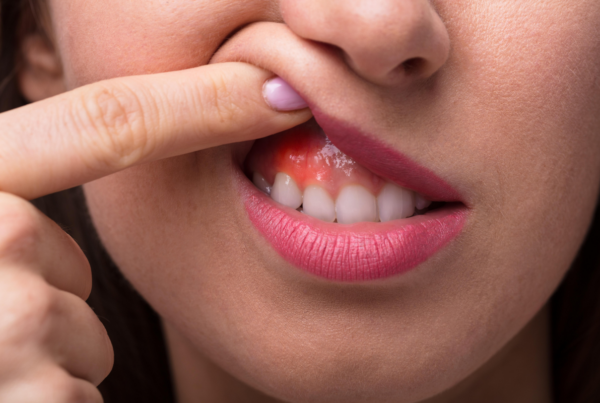

You’re in the middle of a stressful meeting, watching something tense on TV, or simply lost in thought — and then you notice it. Your teeth are clamped down on the inside of your cheek. Again.
For some people, it’s an occasional accident. For others, chronic cheek biting is a daily pattern that leaves the inner cheek raw, swollen, and sometimes ulcerated. The big question most patients ask: is this a psychological habit or a dental problem?
The honest answer: it can be both — and understanding which one is driving yours is the first step toward effective inner cheek bite treatment.
What Is Cheek Biting, Exactly?
Medically referred to as morsicatio buccarum, cheek biting is the repetitive chewing, sucking, or nibbling of the inner cheek lining (buccal mucosa). It ranges from occasional accidental cheek biting during meals to a compulsive, near-unconscious habit that occurs throughout the day.
The inner cheek tissue is delicate. Repeated trauma to the same area leads to thickened, whitish, or ragged patches of tissue — which, in turn, can become even more tempting to bite. It’s a self-reinforcing cycle that’s surprisingly hard to break without addressing the root cause.
Cheek Biting Causes: Anxiety vs Dental Misalignment
There is rarely a single cause for chronic cheek biting. Most patients fall into one of two camps — or a combination of both.
When Cheek Biting Is Driven by Anxiety
The link between cheek biting and anxiety is well-established in psychological research. Repetitive body-focused behaviours — including nail biting, skin picking, and cheek biting — are often how the nervous system attempts to self-regulate during periods of stress or emotional tension.
Signs that anxiety is the primary driver:
- The biting is almost entirely unconscious — you only notice it after it’s happened
- It intensifies during stressful periods (deadlines, conflict, anxiety-inducing situations)
- It happens more when you’re sitting still, concentrating, or watching screens
- You have other body-focused habits alongside it — knuckle cracking, hair twirling, nail biting
- Your teeth alignment is normal, confirmed by a dentist
In psychology, this is often classified under a broader category called Body-Focused Repetitive Behaviours (BFRBs). When cheek biting reaches a level that causes significant distress or tissue damage, it may warrant behavioural therapy alongside dental care.
When Cheek Biting Is a Dental Problem
Equally common is cheek biting caused or worsened by teeth misalignment and cheek biting — a structural issue rather than a psychological one. When the upper and lower teeth don’t meet correctly (a condition called malocclusion), the cheek tissue can get caught between opposing teeth during chewing or speaking.
Signs that dental misalignment is contributing:
- Biting happens primarily during meals, not at rest
- You notice it mostly on one side of your mouth
- You’ve recently had new dental work (crown, filling, denture) that changed your bite
- You grind your teeth at night or clench your jaw
- The same spot keeps getting bitten, suggesting a structural trigger
| ⚠️ Important: A single cheek bite that heals within 1–2 weeks is generally not a concern. It’s the chronic, repetitive pattern — especially one that keeps targeting the same spot — that needs professional evaluation. |
The Risks of Leaving Chronic Cheek Biting Untreated
Beyond the immediate discomfort of a cheek bite injury, repeated trauma to the same area carries real dental and medical risks:
- Mouth ulcers: Open sores from repeated biting are painful and slow to heal when re-injured constantly
- Keratosis: The inner cheek develops thickened, white tissue as a protective response — which can look alarming and is sometimes confused with other oral lesions
- Infection risk: Open sores inside the mouth are entry points for bacteria, particularly if oral hygiene is inconsistent
- Worsening cycle: Thickened or irregular tissue becomes more noticeable to the tongue and teeth, making continued biting almost inevitable without intervention
It’s also worth noting that not every white patch inside the mouth is from cheek biting. Any persistent white or red lesion that doesn’t resolve within two weeks should be evaluated by a dentist to rule out other oral health conditions.
Inner Cheek Bite Treatment: What Are Your Options?
Effective inner cheek bite treatment depends entirely on what’s causing the habit. A proper diagnosis comes first — and that requires a dental examination, not just guesswork.
For Anxiety-Driven Cheek Biting
- Habit awareness training: Simply becoming mindful of when and why you bite is often the first breakthrough. Keeping a log can help identify triggers.
- Behavioural therapy (CBT or HRT): Habit Reversal Training is a specific technique used for BFRBs and has strong evidence behind it. A trained therapist teaches you to replace the biting response with a competing behaviour.
- Stress management: Yoga, breathwork, and regular exercise reduce the baseline anxiety level that drives the habit in the first place.
- Oral guard or barrier: Your dentist may recommend a soft night guard or cheek shield that physically prevents access to the tissue while you work on the underlying behaviour.
For Misalignment-Driven Cheek Biting
- Bite adjustment: If a specific tooth is catching the cheek, a minor reshaping of the cusp (occlusal adjustment) can eliminate the trigger entirely
- Orthodontic correction: Invisible braces or aligners can address malocclusion systematically, correcting how upper and lower teeth meet
- Restoration review: If recent dental work has altered your bite, your dentist can adjust the restoration to eliminate the catching point
- Replacing ill-fitting appliances: Old or poorly fitting dentures are a common and often overlooked cause of chronic cheek biting in older patients
For the Wound Itself
- Antiseptic mouth rinses to prevent secondary infection
- Topical anaesthetic gels for pain relief during healing
- Avoiding spicy, acidic, or hard-textured foods while the tissue recovers
- Maintaining thorough oral hygiene to reduce infection risk
When Should You See a Dentist?
Don’t wait for cheek biting to ‘sort itself out.’ Book a dental evaluation if:
- You’ve been biting the same spot repeatedly for more than 3–4 weeks
- There is a visible white patch, lump, or ulcer that isn’t healing
- The habit is causing you pain, embarrassment, or sleep disruption
- You suspect your bite has changed — especially after recent dental work
- Children are developing a cheek biting habit — early intervention is significantly more effective
Your dentist will examine the affected tissue, assess your bite and alignment, and may refer you to an orthodontist or specialist if structural correction is needed. If gum health is compromised from repeated injury, that will be addressed as part of your treatment plan too.
The Bottom Line
| Cheek biting is more than a nervous habit — it’s a signal worth listening to. Whether it’s rooted in stress and anxiety or triggered by how your teeth fit together, the good news is that both causes are treatable. Inner cheek bite treatment exists for every scenario — the key is understanding which one applies to you.
A five-minute dental check could save you months of repeated injury and discomfort. |
Struggling with chronic cheek biting? Book a consultation at American Dental Practices in Mumbai or Bangalore. Our team will assess your bite, your tissue health, and build a clear, personalised plan — whether the answer lies in orthodontic correction or a simple bite adjustment.