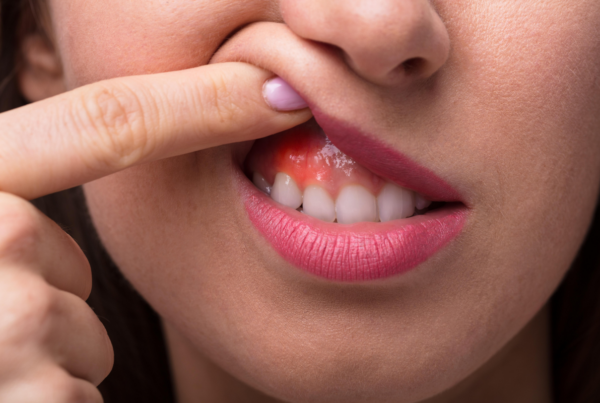


You spit after brushing and the sink is pink. You wake up and notice a faint metallic taste, and your saliva has a reddish tinge. Or it happens with no obvious trigger — you’re not brushing, not eating, just going about your day.
Blood in saliva is something that stops people mid-thought. And rightly so — because while it’s often caused by something straightforward and treatable, the same symptom can occasionally signal something that genuinely needs urgent attention. The cause, frequency, and accompanying signs are what determine whether this is a 5-minute conversation with your dentist or a same-day emergency visit.
This guide covers every significant dental cause of blood in saliva, the red flags that separate minor from serious, and what to do depending on what you’re experiencing.
Is Blood in Saliva Always a Dental Problem?
Not always — but the mouth is where it most commonly originates, and dental causes account for the overwhelming majority of cases. Blood-tinged saliva coming from the mouth is different in nature from blood coughed up from the lungs (which typically appears frothy and bright red and is always a medical emergency). Understanding the source is the critical first step.
If you can trace the blood clearly to your gums, a tooth, or an area of the mouth — it is most likely dental. If the blood appears when you cough, comes up from the throat without any mouth involvement, or is accompanied by chest pain or breathlessness, seek medical attention immediately. This guide focuses on dental and oral causes.
Common Dental Causes of Blood in Saliva
1. Gum Disease (Gingivitis and Periodontitis)
By far the most common reason for blood in saliva after brushing or on waking is gum disease. When plaque builds up along the gum line, the gum tissue becomes inflamed, engorged with blood, and fragile — bleeding readily at the slightest contact. In its early stage (gingivitis), this is entirely reversible with improved oral hygiene. In its advanced stage (periodontitis), it causes permanent bone and tissue loss around the tooth.
- Typical presentation: Pink or red-tinged saliva after brushing or flossing, particularly in the morning when saliva has pooled overnight against inflamed gums
- Other signs: Swollen or tender gums, persistent bad breath, receding gum line, loose teeth in advanced cases — all signs covered in our white gums guide
- Action: Professional dental cleaning, scaling and root planing, and improved daily oral hygiene. Laser gum treatment is available for more advanced cases at ADP
2. Vigorous Brushing or Flossing Trauma
Brushing too hard or snapping floss aggressively against the gum tissue causes small lacerations that bleed into the saliva — often producing a startling amount of pink colour in the sink relative to the minor nature of the actual injury.
- Typical presentation: Brief bleeding immediately after brushing or flossing that resolves within a few minutes
- Action: Switch to a soft-bristled toothbrush. Use gentle C-shaped flossing technique. Review your daily oral hygiene routine
3. Mouth Ulcers or Canker Sores
Open sores inside the mouth — whether from canker sores, cheek biting, or accidental injury — can bleed into the saliva, particularly when they make contact with food, drink, or tongue movement. If you’re a chronic cheek biter, our guide on inner cheek bite treatment is worth reading alongside this one.
- Typical presentation: Localised blood from a visible sore; may be painful or painless depending on the type
- Action: Monitor for two weeks. If the ulcer doesn’t resolve or keeps recurring, have it evaluated — particularly if it’s painless
4. Tooth Extraction or Recent Dental Procedure
Some oozing and blood-tinged saliva for up to 24 hours after an extraction is entirely normal. However, active bleeding that soaks through gauze repeatedly, bright red blood that doesn’t slow down, or blood reappearing days after the extraction has apparently stopped are all signs that need dental review.
If you’re post-extraction and unsure whether what you’re seeing is normal healing or something more concerning, our detailed guide on tooth extraction and dry socket covers exactly what to expect at each stage.
- Action: Bite firmly on gauze for 30–45 minutes. Avoid hot drinks, smoking, and straws. Return to your dentist if bleeding is heavy or doesn’t slow within 2 hours
5. Dental Abscess or Infected Tooth
A tooth or gum abscess — a pocketed bacterial infection — can produce blood-stained discharge into the saliva, particularly if the abscess ruptures or drains through a sinus tract in the gum. This is often accompanied by a sudden relief of pressure and an intensely unpleasant taste.
- Other signs: Throbbing tooth pain, swelling, fever, foul taste, sensitivity to pressure — detailed in our tooth pain causes guide
- Action: Urgent dental visit. Drainage alone does not treat the infection. Root canal therapy or extraction is typically required
6. Blood Thinning Medications
Patients on anticoagulant medications (warfarin, aspirin, newer blood thinners like rivaroxaban) often notice blood in saliva more readily — even minor gum inflammation bleeds more significantly when clotting is suppressed. This does not mean the gums are more diseased, but it does mean the underlying inflammation needs addressing.
- Action: Inform your dentist about all medications at every appointment. Do not adjust medication dosage without consulting your prescribing doctor
7. Dry Mouth and Mucosal Fragility
Persistent dry mouth — from mouth breathing, dehydration, or certain medications — leaves the oral lining fragile and prone to minor bleeding, particularly on waking. This is often the cause of blood in saliva in the morning with no other obvious symptoms. Staying well hydrated and breathing through the nose overnight can make a significant difference.
Blood in Saliva: Is It Urgent?
Use this guide to assess how quickly you need to act:
| Situation | Likely Cause | Action |
|---|---|---|
| Pink saliva after brushing | Gum inflammation | Book a dental check-up |
| Brief bleed after flossing | Gum trauma or disease | Improve technique; review with dentist |
| Blood from visible mouth sore | Ulcer / canker sore | Monitor 2 weeks; see dentist if persists |
| Oozing 24hrs post-extraction | Normal healing | Gauze pressure; rest; monitor |
| Bleeding days after extraction | Dry socket or infection | Return to dentist — do not wait |
| Blood + throbbing tooth pain | Abscess / infection | Urgent dental visit today |
| Blood + fever + swelling | Spreading infection | Emergency — go immediately |
| Blood when coughing, not mouth | Respiratory / systemic | Medical emergency — call doctor |
Red Flags: When Blood in Saliva Is an Emergency
🚨 Seek same-day or emergency care if:
A dental infection that has progressed to spreading swelling and fever is not a ‘book an appointment this week’ situation — it requires same-day professional attention. |
Blood in Saliva With No Pain — Should You Still Worry?
Painless blood in saliva is actually more common than most people expect — and paradoxically, it can sometimes be the version that warrants the most attention. Gum disease in its early stages is often completely painless. So is leukoplakia. So are some oral tumours in their early stages.
The absence of pain does not mean the absence of a problem. If you’re noticing blood-tinged saliva with no pain consistently — particularly in the morning, or more than a few days running — a dental evaluation is the right next step. Catching gum disease before it reaches the bone-loss stage of periodontitis, for instance, makes the difference between a cleaning and a surgical procedure.
It’s also worth checking whether unexplained burning or altered taste accompanies the blood — conditions like Burning Mouth Syndrome (BMS) can present alongside oral tissue fragility in some patients.
Preventing Blood in Saliva: What Dental Care Actually Looks Like
The vast majority of dental causes of blood in saliva are preventable with consistent, correct oral care:
- Brush twice daily for two minutes with a soft-bristled brush — angle the bristles 45° toward the gum line to clean the margin without abrading the tissue
- Floss once daily using a gentle sliding motion — snapping floss into the gum is one of the most common causes of unnecessary gum trauma
- Use an alcohol-free antibacterial mouthwash — high-alcohol rinses can dry and irritate gum tissue over time
- Stay hydrated — saliva is the mouth’s natural defence against bacterial overgrowth and mucosal fragility
- Attend professional cleanings every 6 months — tartar below the gum line cannot be removed by brushing and is the primary driver of periodontitis
For a complete daily routine, our oral hygiene guide covers everything from technique to product choices. And if bad breath accompanies your bleeding gums, our natural mouthwash guide covers the most effective rinse options available in India.
The Bottom Line
| Blood in saliva is not something to dismiss — but it’s also not automatically a reason to panic. In most cases it points to gum inflammation, minor trauma, or a healing wound that just needs professional attention and better daily care. In a small number of cases, it signals something that needs urgent action today.
The rule is simple: if it’s happened more than once, if it comes with pain or swelling, or if you can’t identify a clear harmless cause — see your dentist. Today, not next week. |
Experiencing blood in your saliva and not sure what’s causing it? Book a consultation at American Dental Practices in Mumbai or Bangalore. Our team will examine your gums, teeth, and oral tissue — identify the exact source, and give you a clear, honest treatment plan. From gum treatment to root canal therapy, we have every solution under one roof.